Sunday, August 9, 2009

BUELL 1125R motorcycle wallpapers

Buell 1125R Motorcycle Wallpapers
BUELL Motorcycle, general information, review and specifications

Buell 1125R (2009)

Click Thumbnail to download (size 1600 x 1200 pixels)
Motorcycle Wallpapers, choose by BRANDS>
BUELL Models >


Buell 1125R (2009) Review and Specifications.

For an avid motorcyclist, one of the biggest question marks surrounding AMA Pro Road Racing’s Daytona SportBike class is what it’s like to ride one of these “SportBikes” in full factory race trim. Recently, Motorcycle-USA received just such an opportunity, piloting the Geico Powersports Richie Morris Racing Buell 1125R racebike around Road America’s 4-mile road course in Elkhart Lake, Wisconsin.

In our Daytona SportBike street bike comparison we determined that, indeed, a production 2009 Buell 1125R has a performance advantage when compared to its class rivals - including the 2009 Kawasaki Ninja ZX-6R and Aprilia RSV1000R. But how does it compare to the stock motorcycle which it’s based off of? To our surprise, it isn’t all that different.

In order to create better parity within the class, the DSB series rules don’t allow a whole lot of engine modifications. Instead the rules package gives more leeway for chassis modifications. Thus many of the team’s modifications are focused in that area.

Most apparent is the bare finish on the racebike’s aluminum frame and braced swingarm, which also allows for a conventional chain/sprocket final drive as opposed to the stock belt drive. It’s also surprising how much different the bike looks with race plastics. The lower fairing and tail sections make the 1125R racebike look closer to a Japanese or European sportbike, until your eye catches those two huge air scoops on either side as well as its oversized upper fairing, which remind you it’s all Buell.

Hop aboard the machine and notice its hard, slightly shorter seat. Designed to not only lower the rider’s center of gravity, the racing perch enhances feel between the rider and the back end of the motorcycle. Reaching forward to the handlebars, the rider feels more tucked in with the torso angled more closely to the bike. Placing feet on the footpegs, knees will tuck up into the bike's pseudo fuel tank much tighter than in the stock position. While the ergonomic changes aren’t exactly radical, they do enable the rider to direct more of his or her weight towards the front of the motorcycle. (Adam Waheed)

General information

Model: Buell 1125R
Year: 2009
Category: Sport
Rating: 71.1 out of 100.

Engine and transmission
Displacement: 1125.86 ccm (68.70 cubic inches)
Engine type: V2
Stroke: 4
Power: 146.00 HP (106.6 kW)) @ 9800 RPM
Torque: 111.19 Nm (11.3 kgf-m or 82.0 ft.lbs) @ 8000 RPM
Compression: 12.3:1
Bore x stroke: 103.0 x 67.5 mm (4.1 x 2.7 inches)
Fuel system: Injection. Dual 61 mm down draft throttle bodies, DDFI III fuel injection
Valves per cylinder: 4
Fuel control: DOHC
Starter: Electric
Cooling system: Liquid
Gearbox: 6-speed

Transmission type
final drive: Belt
Clutch: Wet, multi-plate, Hydraulic Vacuum Assist (HVA) slipper – action clutch, hydraulic clutch lever effort

Physical measures
Overall length: 1,996 mm (78.6 inches)
Overall width: 716 mm (28.2 inches)
Ground clearance: 114 mm (4.5 inches)
Wheelbase: 1,387 mm (54.6 inches)

Chassis and dimensions
Frame type: Black aluminium frame, fuel in frame
Rake (fork angle): 21.0°
Front suspension: 47 mm Showa inverted forks with adjustable compression damping, rebound damping and spring preload
Front suspension travel: 120 mm (4.7 inches)
Rear suspension: Showa coil-over monoshock with external piggyback reservoir and adjustable compression damping, rebound damping and spring preload
Rear suspension travel: 127 mm (5.0 inches)
Front tyre dimensions: 120/70-ZR17
Rear tyre dimensions: 180/55-ZR17
Front brakes: Single disc. ZTL2-type brake, 8-piston, 4 pads, fixed caliper, single-sided, inside out, stainless steel, floating rotor
Front brakes diameter: 375 mm (14.8 inches)
Rear brakes: Single disc. Two-piston, direct mount caliper; stainless steel, fixed rotor
Rear brakes diameter: 240 mm (9.4 inches)
Exhaust system: Tuned, tri-pass resonance chamber with integral helmholtz tuning and mass-centralised mounting

Other specifications
Fuel capacity: 20.06 litres (5.30 gallons)
Color options: Racing Red, Arctic White, Midnight Black.

Saturday, August 8, 2009

BUELL 1125R motorcycle pictures

Buell 1125R Motorcycle Wallpapers
BUELL Motorcycle, general information, review and specifications

Buell 1125R (2008)

Click Thumbnail to download (size 1600 x 1200 pixels)
Motorcycle Wallpapers, choose by BRANDS>
BUELL Models >


Buell 1125R (2008) Review and Specifications.

The recent unveiling of Buell's all-new liquid-cooled V-Twin superbike sneaked up on most everyone, but the cry for such a machine from Buell has been in the wind for years.

"If only it had a modern, liquid-cooled engine," was often the plea of so many who would characterize their thoughts on Buells as, "I wanna like you, buuut..."

Has a partnership with BRP-Rotax given Buell lovers and those vacillating on a purchase what they've clamored for?

As fate would have it, in the matter of one phone call I went from pondering the above question like everyone else to seizing the opportunity to attend the 1125R intro. The much-chronicled roads surrounding Monterey, CA, would serve as real-world proving grounds, and Laguna Seca, home of the U.S. MotoGP would be the race track du jour.

In case you didn't get a chance to read our Buell 1125R First Look in early August, we'll go over some of the specs here. Developed in conjunction with BRP-Rotax, makers of the 998cc 60-degree V-Twin engine in the Can-Am Spyder as well as a similar motor found in modern Aprilias, Buell specified an 1125cc liquid-cooled fuel-injected 72-degree DOHC eight-valve V-Twin as the heart of the machine.

So why choose 1,125 cubic centimeters resulting from the oversquare 103mm x 67.5mm bore and stroke? According to Buell, these dimensions produce the best marriage of broad, available torque and horsepower. Compression ratio is 12.3 :1.

Equally as uncommon today is the 72-degree angle. Abe Askenazi, Director of Analysis, Test and Engineering Process, stated that Buell is aware that a 90-degree Vee has better primary balance, but 72-degrees proved ideal for the best gas flow path as well as being a more compact design. Engine vibes were anticipated, so three balancers were employed (two to cancel primary rotating imbalance, the third canceling out rocking couple).

Not all the buzz has been eliminated, as you would expect from a rigid-mounted engine serving as a stressed member of the chassis. The remaining vibes are palatable, never really impacting comfort or performance. Coincidentally, the tach needle does suffer in an amusing manner. As it reaches the upper rpm range, it appears to be resonating at such a rate that it "grows," blurring your reading over roughly a 500 rpm span. Not a problem, really, just kind of funny.

Since this engine is a clean-sheet design, it has some unique features. For example, the process of opening and closing the 41.3mm intake and 35mm exhaust valves. A self-adjusting cam chain drive and gear operates the intake cam that in turn meshes with a gear on the exhaust cam. Finger followers (more often found in automotive use, especially with Less bits mean less material to spin around which, in turn, should equate to a faster motor.variable valve actuation systems) are used instead of more traditional tappets. Acting directly on shims over the valve, the follower's linear movement eliminates the need for buckets.

But it doesn't end there. Are you a do-it-yourselfer? Buell hasn't forgotten about you. After rotating the engine forward a bit you can remove the magnesium valve cover and access a simple plastic clip that retains the finger followers. Slide the followers to the center and you're grabbing at those V-Rod spec shims in no time, about every 12,400 miles. This is, of course, an abbreviated version of the work involved, but as someone who has done countless valve adjustments I can really appreciate this.

Capitalizing on the unused resource of vacuum in the manifold generated by the massive 61mm throttle bodies, Buell came up with its version of a back-torque-limiting clutch, similar again to the Aprilias. Just inside the outer clutch cover you'll find the usual hydraulic slave cylinder and a big diaphragm. A simple tube or hose connects the manifold to the outer cover. Separated from the clutch that's thrashing around in oil that could potentially ruin sealing, the diaphragm gets pulled outward against the clutch-release mechanism when the throttle is fully closed, or roughly three percent open. This creates enough vacuum to relieve pressure on the clutch to keep it from fully compressing. Any greater throttle openings create low vacuum and the clutch stays tightly clamped.

The end result is a very light pull (when the engine is running, of course, otherwise there's no vacuum) at the adjustable hydraulic lever and smooth, trouble-free, shifting in the Japanese-quality six-speed tranny.

Rapid downshifting for quicker corner entry speeds without fear of the rear tire hopping on the tarmac is another benefit of slipper-type clutches. The Buell system works quite well. However, I was able to get the rear to dig in a little, protesting with a little squirm and slide after stepping down one gear to many. But it was over in a heartbeat and completely manageable.

Another thoughtful addition on this bike is the use of a compensator within the transmission sprocket instead of in the rear wheel. Again, the idea being less unsprung weight. A traditional belt-drive (wouldn't be a Buell without it!) is utilized for its lightweight, strength and longevity.

A large 12-liter airbox extends a long snorkel out into the high pressure area that is between the fork legs to pressurize the airbox at high speeds.

Air that's able to sneak past the hungry hippo airbox either gets whisked over the rider via bodywork that underwent extensive wind tunnel testing, or it blows across twin side-mount radiators. Cool air that flows over the radiators passes through either a channel between the engine and frame exiting near the rear of the bike, or down to the rider's tootsies. You can say that again. More than one of us got a hot foot on the shift side. None of us could pin down whether the heat was radiating off the warm-running engine or if it came from the "air flow" or exhaust.

Two rather bulbous pieces of bodywork, one on each side and just below the upper fairing, do double duty as radiator air scoops and frame protectors. If you know newer Buells you know that they have a puck on the out most location of the frame spar acting as crash protectors. When the designers and engineers created the radiator cowling on the 1125R, they knew they had some cosmetic liability to deal with, so they just made them able to absorb a tipover or crash.

Because of their shape and an opposing metal strip behind the outer cowling, the whole thing acts like a leaf spring to soak up the blows. Best of all, the outer color-molded piece that usually gets the raw end of the deal is cheap to replace, according to Buell tech staff. Before the week was out, this would get tested. Those odd-looking radiator covers performed well, keeping any victim bikes off the bench and in the game. (Yippe! Yippe! It wasn't Pete! –Ed.)

Early figures from Buell had 146 hp coming on at 9800 rpm with 82 ft.-lbs of torque peaking at 8000 rpm. Seems that it'll probably take an unbiased dyno run or three to get the truth out of the Helicon engine as press materials indicated 146 hp without ram air at 10,500 rpm, torque claims remaining unchanged. Still another figure of peak power at 10,200 rpm was reported to Motorcycle.com by Tony Stefanelli, Platform Engineering Director for Buell. Turns out that the 10,500 rpm mark is more accurately described as redline. Three-hundred rpm aside, what really matters is how accessible power is in this Austrian-influenced mill.

From my seat-o'-the-pants dynamometer, the lion's share of the torque is available as early as 3500 rpm. Power builds rapidly in a most linear manner with a perceptible boost at somewhere between 6500 to 7000 rpm.

Nuances about where peak power resides matter little because this much is true: power is available instantly and seamlessly all the way to that 10,500-rpm redline. But there's never a sensation of seemingly uncontrollable acceleration as with, say, some of the current supersports or superbikes. You know the type. One minute you're feeling like a star then peak power hits in the stratosphere. It's only after you've parked for the day that you notice that the hands on your watch stopped at precisely the moment you tapped into that peaky inline-Four power pack. Nope, none of that happens on the 1125R. Just linear, manageable fun.

This cutting-edge V-Twin allegedly took more than four years to develop, and the chassis was close behind. Now truly American-made (instead of the other Buells’ Italian Verlicchi chassis), the frame looks and acts like a typical Buell frame. It carries over 5.6 gallons of fuel but has been re-tuned for additional torsional rigidity. The cast-aluminum swingarm on the other hand is a different story. Its pivot point was moved forward into the rear of the engine case for added rigidity in the overall chassis package. The biggest difference, though, is that it doesn't work as an oil tank. The 1125R has a dry-sump oil system and uses a simple paper filter element (old skool, baby!) in the engine, leaving the swingarm to do what it does best: swing. Weighing in one pound lighter and 57-percent stiffer than previous Buell swingarms, you have to wonder just how stiff and rigid things need to be before you can ride them.

A linkage-less Showa shock with a nine-position preload is adjustable for compression and rebound damping. It worked perfectly for anything I was able to throw at it. Up front are possibly the beefiest forks I've ridden to date. Forty-seven millimeter Showa forks with adjustable compression, damping and preload worked brilliantly... once I got on the right bike, that is. It seems that Buell is still sorting out a few issues (more on that later) on what they call "production intent" with respect to the fork spring rate. The direction they hope to head for the final product is a .95 kg/mm spring, but many of the bikes being ridden had a firmer 1.0 spring up front.

After hopping between the heavier and lighter spring bikes (when one was available), it wasn't until the final two sessions of track time that I was finally comfortable with preload settings. But those were my two best sessions. I was able to rush up on the corner, flip it in, shove on the bar with abandon and dig in my knee. The front never budged, giving great feedback from the excellent Pirelli Diablo Corsa IIIs.

The test bike I was on for the street ride offered a plush ride without compromising with a mushy front end. Unfortunately, when the pace was kicked up a notch, the heavier-rated front end provided a disconcerting experience of skittering over choppy pavement, leaving me to lean heavily on the pseudo fuel tank in order to keep the front stuck to the pavement.

Speaking of leaning on the tank, even with a claimed 54-percent weight bias, keeping the front down at times was a chore. A fun chore, mind you, but something to be conscious of nonetheless. With a relaxed-for-a-Buell 54.6-inch wheelbase, a 21-degree steering angle and 3.3 inches of trail, the 1125R shook its head more than once. Not so much because of treacherous geometry, but the darn thing just wants to reach for the sky when you're heavy handed on the throttle. In my opinion the 1125R would benefit from a steering damper. Especially since it can accommodate one from the XBRR racing kit. The reality is that many similarly priced Japanese literbikes have dampers as standard equipment.

No matter, though, because it could all be reeled in by the single, big hoop 375mm perimeter-mounted front rotor/caliper combo. Snatched right from the XBRR, the eight-piston ZTL² brake is among the best available. Similar to the ZTL found on other Buells, this system has a number of advantages inherent in its design. For one, braking forces go straight to the rim, thereby removing most of the torsional load on the rest of the wheel. Hence the "Zero" in Zero Torsional Load (ZTL and ZTL²). Subsequently, a lighter wheel can be used, with lighter steering as the benefit. I can only hope other makes will grasp this concept, soon.

A final ode to innovation on the 1125R is the rear brake. In order to walk the line of less unsprung weight, the rear caliper is mounted directly to the backside of the swingarm. In profile, all you can see is the 240mm rear rotor. Again, service techs were championed by someone inside the 1125R design team. A series of evenly-spaced large holes in the rotor grant access to caliper mount bolts without removing the wheel. Too bad they couldn't make the brake perform any better. Like most Buells I've ridden, the rear brake lacked feel and required an unusual amount of effort to brake effectively.

Sounds mostly like a glowing review of a brand new bike, right? Certainly a few hiccups surfaced, but we were admonished to mention that the bikes were all pre-production models. The stumble and surge in the fueling that seemed worst while trolling at low revs is a known issue. Likewise, the final spring rate for the shock is undetermined as of yet. Also, the ambient air temp display isn't so ambient. In production, the plan is to move the sensor closer to the front of the bike and have the ECU freeze the reading as it feels the bike begin to slow or stop so as to better reflect ambient air.

Other electric gremlins included a fuel light that appeared to come on early. It also appeared at the time that no safety cut-out switch existed for a deployed kickstand when the bike is put in gear.

Since the bikes were built under severe time constraints, we're willing to give Buell the benefit of the doubt when they say that all issues that continue to be in the final calibration process will be completed by the time the $11,995 American superbike hits dealers in late '07.

Claimed dry weight on the 1125R is 375 pounds. Buell measures the 421-pound wet weight as "wet minus fuel" because the 5.6 gallon fuel capacity is the largest in its class. Measuring with fuel would make it seem disproportionately heavy. The 421 is allegedly one pound lighter than the Ducati 1098.

Comparatively speaking:
'07 GSX-R1000 dry = 379 lbs. $11,399;
'07 Aprilia Tuono 1000R dry = 407 lbs. $12,999;
'08 Ducati 1098 dry = 381 lbs. $15,995;
'06 Honda RC51 (still listed on Honda website as an available model) dry = 439 lbs. $11,999 (Zoinks!)

Is this the Buell we've all been waiting for? Paul James, Director of Product Communications, told Motorcycle.com that, "We think this bike will bring customers over the threshold of a Harley/Buell dealer who normally wouldn't do such a thing."

Nearly two hundred miles on the street and a day at Laguna Seca gave me plenty of time to determine that Buell has truly upped its game and has a very real chance of making some serious trouble for other V-Twin sportbikes of similar displacement available today. And it appears they'll do it for about the same cost as most, and thousands less in some cases.

The greatest strength of the 1125R is the readily available and very practical low- and mid-range bang. It's this kind of usable power that will bail most riders out from poor gear selection or wrong entry speed, salvaging the corner and their ego at the same time. (By Pete Brissette, Aug. 29, 2007)

General information
Model: Buell 1125R
Year: 2008
Category: Sport
Rating: 68.2 out of 100.

Engine and transmission
Displacement: 1125.86 ccm (68.70 cubic inches)
Engine type: V2
Stroke: 4
Power: 146.00 HP (106.6 kW)) @ 9800 RPM
Torque: 111.19 Nm (11.3 kgf-m or 82.0 ft.lbs) @ 8000 RPM
Compression: 12.3:1
Fuel system: Injection. Dual 61 mm down draft throttle bodies, DDFI III fuel injection
Valves per cylinder: 4
Fuel control: DOHC
Starter: Electric
Lubrication system: Dry-sump with integrated oil reservoir in lower crankcase
Cooling system: Liquid
Gearbox: 6-speed
Transmission type
final drive: Belt
Clutch: Wet, multi-plate, Hydraulic Vacuum Assist (HVA) Slipper Action Clutch, hydraulic clutch lever effort

Physical measures
Dry weight: 170.1 kg (375.0 pounds)
Overall length: 1,996 mm (78.6 inches)
Overall width: 716 mm (28.2 inches)
Ground clearance: 114 mm (4.5 inches)
Wheelbase: 1,387 mm (54.6 inches)

Chassis and dimensions
Frame type: Aluminum frame, fuel in frame
Rake (fork angle): 21.0°
Front suspension: 47 mm Showa inverted forks with adjustable compression damping, rebound damping and spring preload
Front suspension travel: 120 mm (4.7 inches)
Rear suspension: Showa coil over monoshock with adjustable compression damping, rebound damping and spring preload
Rear suspension travel: 127 mm (5.0 inches)
Front tyre dimensions: 120/70-ZR17
Rear tyre dimensions: 180/55-ZR17
Front brakes: Single disc. 8-piston calipers
Front brakes diameter: 375 mm (14.8 inches)
Rear brakes: Single disc. 2-piston calipers
Rear brakes diameter: 240 mm (9.4 inches)
Exhaust system: Tuned, tri-pass resonance chamber with integral helmholtz tuning and mass-centralized mounting

Speed and acceleration
Power/weight ratio: 0.8584 HP/kg

Other specifications
Fuel capacity: 21.19 litres (5.60 gallons)
Color options: Midnight Black, Diamond Blue Frame

BUELL 1125CR motorcycle wallpapers

Buell 1125 CR Motorcycle Wallpapers
BUELL Motorcycle, general information, review and specifications

Buell 1125CR (2009)

Click Thumbnail to download (size 1600 x 1200 pixels)
Motorcycle Wallpapers, choose by BRANDS>
BUELL Models >


Buell 1125CR Review and Specifications.

Buell took a page from the simplicity of design of the XB streetfighter models and applied the iconic stripped-down philosophy to the company’s first and only liquid-cooled sportbike, the 1125R. Called the 1125CR, this nearly-identical sibling of the racier-looking 1125R loses the big fairing/windscreen found on that bike in favor of a minimalist flyscreen sitting atop on new, single piece headlight. The new Buell also has slightly lower (about 8% from the 1125R) final drive gearing for improved acceleration according to Buell materials. We say that means even easier wheelies. Everything else on 1125CR is carried over from the 1125R.

We can easily imagine the C stands for café as Erik Buell gives his insight on the bike. “Part superbike and part streetfighter, the 1125CR is my vision of a 21st century café racer,” said Buell. “It’s got Clubman-style bars and a flyscreen instead of a fairing...”

Something the CR version of the 1125 will receive that the R version will also get is targeted fuel injectors, relocated O2 sensors, and updated engine spark and fuel maps. A day late in our book. Drats! Okay, we’re miffed we didn’t wait a little longer to test a 2009 1125R; the test unit in our recently published 2008 Oddball Literbike Comparison suffered from poor fueling at small throttle openings. But, we’re glad Buell was listening to those in the press as well as 1125R customers with similar issues! If these revisions clear up the rough running problems of the 1125R, and now 1125CR, these machines should be an even bigger hit than they already are (or hopefully will be in the CR’s case). Best of all is that this fix will be available for existing 1125R machines from 2008. Get to your Buell dealer ASAP if you got a bummer!
According to Buell materials this fix will provide “improved drivability below 6000 rpm, even crisper throttle response, improved heat management, and significantly improved fuel economy.”

2009 Updates for XB line

Buell XB Lightning Streetfighters, powered by an air/oil/fan-cooled Thunderstorm V-Twin, get a new look thanks to a blacked-out frame, forks, engine and other components. Lightning models powered by the Thunderstorm 1203 engine upgrade to the Buell ZTL2 front brake with four-pad, eight-piston caliper, a design that debuted on the 1125R in 2008. The XB12Ss gets fitted with the same supermoto-inspired suspension as the 2008 XB12STT, and the new seat on the 2009 XB9SX lowers the seat height by 1.3 inches to 30.1 inches.

The race-bike-like XB12R enjoys these same updates as well as new Pirelli Diablo Corsa III tires.

All 2009 Buell XB models will be fitted with a new, more durable Veyance Hibrex drive belt with Flexten Plus technology, the same belt technology that was originally developed for the Buell 1125R.

2009 Updates for Ulysses and Ulysses Short

The sport-touring Buell Ulysses XB12XT, introduced mid-year 2008, joins the versatile, all-road Ulysses XB12X in the 2009 Buell Adventure Sportbike category. Both models feature new aluminum footpegs with an aggressive “sawtooth” pattern. The new Buell Ulysses Police XB12XP is a “special duty” motorcycle intended for government agencies and private security firms requiring a quick and nimble pursuit-and-patrol vehicle capable of travel over a variety of road surfaces. It comes equipped with a special wiring harness for easy installation of an Emergency Response Kit, which includes special compact, hard-shell top and side cases, a siren, and LED police pursuit lamps.

2009 Blast gets new paint, and two Buells go the way of the dodo

For 2009, the Blast is offered in new Sunfire Yellow, and Midnight Black, both with Stardust Silver wheels. Lastly, the Lightning XB12S and Lightning Super TT XB12STT will not be produced for 2009. Too bad on the SuperTT, that was a fun bike.

General information
Model: Buell 1125CR Cafe Racer
Year: 2009
Category: Naked bike
Rating: 70 out of 100.

Engine and transmission
Displacement: 1125.86 ccm (68.70 cubic inches)
Engine type: V2
Stroke: 4
Power: 146.00 HP (106.6 kW)) @ 9800 RPM
Torque: 111.19 Nm (11.3 kgf-m or 82.0 ft.lbs) @ 8000 RPM
Compression: 12.3:1
Bore x stroke: 103.0 x 67.5 mm (4.1 x 2.7 inches)
Fuel system: Injection. Dual 61 mm down draft throttle bodies, DDFI III fuel injection
Valves per cylinder: 4
Fuel control: DOHC
Cooling system: Liquid
Gearbox: 6-speed

Transmission type
final drive: Belt
Clutch: Wet, multi-plate, Hydraulic Vacuum Assist (HVA) slipper – action clutch, hydraulic clutch lever effort

Physical measures
Seat height: 775 mm (30.5 inches) If adjustable, lowest setting.
Overall length: 2,065 mm (81.3 inches)
Overall width: 744 mm (29.3 inches)
Ground clearance: 138 mm (5.4 inches)
Wheelbase: 1,384 mm (54.5 inches)

Chassis and dimensions
Frame type: Black aluminium frame, fuel in frame
Rake (fork angle): 21.0°
Front suspension: 47 mm Showa inverted forks with adjustable compression damping, rebound damping and spring preload
Front suspension travel: 120 mm (4.7 inches)
Rear suspension: Showa coil-over monoshock with external piggyback reservoir and adjustable compression damping, rebound damping and spring preload
Rear suspension travel: 127 mm (5.0 inches)
Front tyre dimensions: 120/70-ZR17
Rear tyre dimensions: 180/55-ZR17
Front brakes: Single disc. ZTL2-type brake, 8-piston, 4 pads, fixed caliper, 375 mm single-sided, inside out, stainless steel, floating rotor
Front brakes diameter: 375 mm (14.8 inches)
Rear brakes: Single disc. Two-piston, direct mount caliper; stainless steel, fixed rotor
Rear brakes diameter: 240 mm (9.4 inches)
Exhaust system: Tuned, tri-pass resonance chamber with integral helmholtz tuning and mass-centralised mounting

Other specifications
Fuel capacity: 20.06 litres (5.30 gallons)
Color options: Midnight Black; Racing Red

BENELLI Tre 1130 K motorcycle wallpapers

Motorcycle Wallpapers
BENELLI Motorcycle, general information, review and specifications

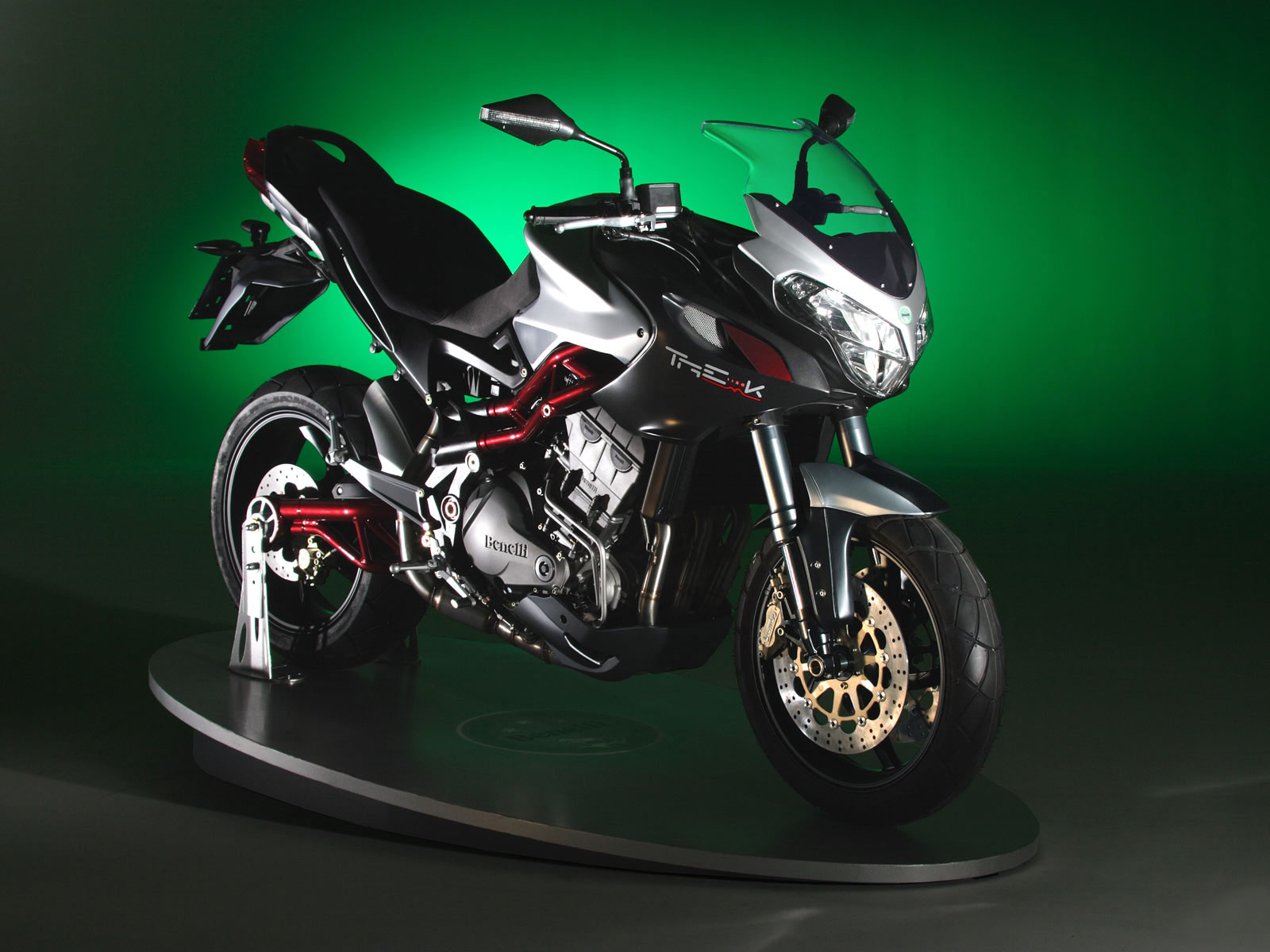
Benelli Tre 1130 K (2006)
Click Thumbnail to download (size 1600 x 1200 pixels)


Why should you stop when the road ends? We live on the same horizon, but we have different views. That’s Benelli’s answer to the riders who go further!


Benelli Tre 1130 K Review and Specifications.

Arguably the most ‘complete’ motorcycle from Benelli in modern times. It may be ironic that the best bike this Italian firm, which is steeped in racing history, has built isn’t a superbike, but the Benelli Tre K is a superb, Multistrada-esque, do-anything, all-purpose street motorcycle and it really is very, very good.

Engine

Big Benellis have rasping in-line-three-cylinder engines and the Tre K is no different. Its 1030cc motor is also used in the Café Racer, TNT and Tornado but for the Tre K is retuned for mid-range usability. As well as making a beautiful high-pitched racket like a NASCAR on helium when you thrash it, there’s a nice spread of usable power right through the rev-range too.

Ride and Handling

One of the things that makes the Benelli Tre K so good is its versatility on the road. An upright riding position, soft suspension, comfy seat and decent wind protection make it easy to live with but it also rewards when you want to play. The Benelli Tre K's supple suspension offers lots of control and the chassis won’t go all wobbly at the knees during bouts of hard riding.

Equipment

Standard fare is on par with the Benelli Tre K’s closest rival: the Ducati Multistrada. There are no real juicy gadgets or ABS but you get a decent half-fairing with adjustable screen to keep off windblast on long journeys, and there are panniers and sat nav available as options.

Quality and Reliability

There are plenty of nice touches on the Benelli Tre K such as a beautifully made tubular steel frame and swingarm, the styling is funky and quality items like Marzocchi forks, Brembo brakes and an Extreme Tech rear shock come as standard. With new management, a new UK importer and stricter quality control, Benelli is addressing reliability problems of old.

Value

Costing £8349 the Benelli Tre K is a lot of bike for the money. It’s fun, easy to ride and versatile; the badge on the tank adds extra kudos too. This could be the bike that takes Benelli forward into the 21st Century.


General Information
Model: Benelli Tre-K 1130 2006
Category: Touring

ENGINE
Type: 1130 cc, water cooled, 3 - cylinders in line, 4-stroke
Bore x stroke (mm): 88 mm x 62 mm
Compression ratio: 11.9:1
Valves: DOHC, 4 valves per cylinder
Fuel system: electronic injection with 1 injector per cylinder
Ignition: single coil inductive discharge electronic ignition
Power: 123.4 hp (92 kW) @ 9000 rpm
Torque: 115 Nm (84.8 ft. lbs) @ 6250 rpm
Lubrication system: wet sump

TRANSMISSION
Clutch: dry clutch
Gearbox: 6 speed
Ratios: 1e 14/39, 2nd 18/35, 3th 21/32, 4th 23/30, 5th 24/28, 6th 25/26
Primary drive: 44/79
Final drive: Chain, 16/34
Starting system: Electronic

CHASSIS
Frame:mixed solution. Front: ASD steel tube trellis,fastened to boxed rear section, aluminium alloy castings Subframe: aluminium die-cast
Front suspension: Marzocchi 50 mm diameter “upside down” fork, 150 mm travel
Rear suspension: ASD steel tube trellis swingarm with Extreme Technology single shock absorber with adjustable rebound and spring pre-load, 150 mm travel
Rake / Trail: 25 degrees

WHEELS
Wheels: Die-cast aluminium alloy
Front wheel: 3.50 x 17
Rear wheel: 6.00 x 17
Front tyre: 120/70-17
Back tyre: 180/55-17
Front brakes: dual 320 mm discs with 4-piston calipers
Rear brakes: single 240 mm disc with 2-piston calipers

DIMENSIONS
Overall length: 2183 mm (85.9 inches)
Overall width: 850 mm (33.5 inches)
Overall height: 1320 mm (52 inches)
Seat height: 810 mm (31.9 inches)
Wheelbase: 1514 mm (59.6 inches)
Fuel capacity - reserve: 22 l (5.8 gallon US) - 4 l (1.1 gallon US)
Dry weight: 205 kg (451.9 pounds)

BENELLI Tornado Tre Novecento RS wallpapers

Motorcycle Wallpapers
BENELLI Motorcycle, general information, review and specifications

Benelli Tornado Tre Novecento RS (2005)
Click Thumbnail to download (size 1600 x 1200
pixels)


Benelli Tornado Tre Novecento RS Review and Specifications.

The Benelli Tornado Novecento Tre RS is a restyled version of the Tornado Novecento Tre, which has received a black frame, swingarm and steering plate. The Novecento Tre RS has the same 900 cc engine, but this three-cylinder version has new runners and optimized software for the injection control unit.

General Information
Engine
Type: 4-stroke, 3 Cylinders In Line, Inclined Forward 15°, Equipped With Anti-vibration Counterbalance Shaft.
Displacement: 898 cm3
Bore X Stroke: 3.5x1.9 in (89 X 48 mm)
Compression Ratio: 11:1
Horsepower: 141/11.5 (Hp)RPM
Torque: 74/8.5 lb-ft/RPM (100/8.5 Nm/RPM)
Fuel System: Electronic Injection With 1 Injector Per Cylinder

Transmission
Gearbox: Six Gears, Fully Removable
Clutch: Wet Clutch
Primary Drive: Gear
Final Drive: Chain

Chasses
Frame: Mixed Design. Front Trusses In ASD Tubular Steel Securely Fitted With Traction Screws With Aluminium Alloy Casting Rear Section. Steering Head Angle Fixed 23,5°
Front Suspension: Marzocchi Upside Down Stanchion Fork Diameter 50 Mm, Adjustable In Compression And Extension With Spring Pre-load
Rear Suspension: Asymmetric Swingarm, Composed Of Cast Aluminium And Pressed In Aluminium Alloy, With “Extreme Technology” Single Shock Absorber Adjustable In Compression, Duel Regulation For Low And High Speed Damping And Extension And Spring Pre-load.
Front Brake: Brembo, Double Floating Disk, Diameter 320 Mm, With Twin Radial 4-piston Caliper
Rear Brake: Brembo, With Single Disk, Diameter 240, With Twin Piston Caliper.

Dimension
Overall Length: -
Overall Width: -
Seat Height: 30.7 in (780 mm)
Weelbase: 55.9 in (1420 mm)
Ground Clearance: -
Weight: 430 lbs (195 kg)
Fuel Capacity: 2.4 gallons

Tyres
Front: 120/70x17
Rear: 190/50x17

BENELLI Tornado Tre Novecento motorcycle wallpapers

Motorcycle Wallpapers
BENELLI Motorcycle, general information, review and specifications

Benelli Tornado Tre Novecento (2004)
Click Thumbnail to download (size 1600 x 1200 pixels)

BENELLI Tornado Tre 1130 motorcycle wallpapers

Motorcycle Wallpapers
BENELLI Motorcycle, review and specifications


2006 Benelli Tornado Tre 1130
 Click Thumbnail to download (size 1600 x 1200 pixels)